The compute market is bespoke, super customizable, but also inflexible. You can rent a GPU in minutes. You can also sign a $240 million deal for computing capacity scheduled to arrive next year. Between those purchases sit chipmakers, cloud companies, inference providers, data-center operators, and lenders. Their contracts determine who gets capacity, who pays while it sits idle, and who carries the risk when demand changes.
Contents
- What does compute mean?
- How do you buy compute power?
- Who supplies compute?
- The compute supply chain
- Why delivery can take minutes or years
- Where data centers are taking shape
- What deployment looks like month by month
What does compute mean?
In the world of AI, people often use "compute" for several related things.
- The machines. Servers contain processors such as CPUs and GPUs. GPUs can perform many calculations in parallel, which makes them useful for AI workloads. Memory, networking, storage, and power help turn those chips into a working system.
- Training. Running calculations that adjust a model's parameters so it learns patterns from data.
- Inference. Running an already trained model on new input. When a coding agent asks a model to explain a function or generate a patch, that model run is inference.
- Capacity over time. A GPU-hour means access to one GPU for an hour. Its usefulness depends on which GPU, the surrounding system, and the workload.
Now, a buyer can purchase the equipment, access to the equipment, or a service that runs on it.
How do you buy compute power?
If you're buying compute, the first choice is how much of the work you want your team to take on. You can own the servers and arrange everything around them, rent machines that someone else maintains, or pay a provider to run the model for you. Each option leaves you with a different set of responsibilities.
| Purchase | What the buyer receives | A simple example | What the buyer takes responsibility for |
|---|---|---|---|
| GPU servers | Physical equipment the buyer owns | Buy servers and install them in a rented data-center space | Hosting, power, networking, maintenance, and software, with contractors if needed |
| Time on machines | Access to specified computing resources for an agreed period | Rent eight GPUs for a week | The model and workload software, unless a managed service is included |
| A model service | Access through an API, the interface your software uses to send input and receive model output | Send a code file and ask a hosted model to explain it | Connecting the service, evaluating answers, and managing usage |
Who supplies compute?
| Provider type | Examples | What it contributes | Important notes |
|---|---|---|---|
| Large cloud providers | AWS, Azure, Google Cloud, Oracle, IBM Cloud | Computing infrastructure alongside storage, databases, networking, and security | They can sell both machine access and managed AI services. Existing enterprise systems can influence the choice |
| Specialist AI clouds | CoreWeave, Nebius, Lambda | GPU infrastructure for AI workloads, from individual machines to clusters, groups of connected servers | The amount of software they manage depends on the product. Specialization does not mean they sell only bare machines |
| Inference providers | Together AI, Fireworks AI | A running model, request scheduling, and serving operations | They may obtain infrastructure from another cloud. Dedicated inference can combine reserved resources with a managed model |
Btw, buying inference just means paying someone to run a model for you. Your application sends the input and gets the output back, while the provider deals with keeping the model running. Whether it uses shared machines or resources reserved for you changes the terms of the service, but you're still buying someone else's help operating the model.
If you want to run inference yourself, you can, broadly speaking, do three things.
- Run a model locally on your device. This works when the model fits and your device can run it fast enough. We'll focus here on buying capacity for workloads that need more resources than one device can provide though :).
- Rent machines. You choose the hardware and region, check what's available, and install your model and software on the rented machines. The cloud provider looks after the physical equipment, while your team handles running the model and responding to requests.
- Buy servers. Along with getting a hardware quote, you'll need somewhere to put the equipment and a way to power, cool, connect, and maintain it. You can hire others to handle parts of that work, but those arrangements are now yours to make.
Say you already know which model you want to run. With a GPU rental from Nebius or Lambda, your team gets access to machines and does the work of running that model. With Together AI's dedicated inference, you can choose the model and reserve resources while Together AI operates the service that handles your requests. You might use similar hardware underneath either arrangement, but you're paying for a different amount of help.
The compute supply chain
Even when you buy everything through one cloud company, that company depends on other suppliers. Someone has to make the chips, assemble the servers, and provide a building with enough electricity and cooling to run them. Following that chain helps explain why a shortage of power can matter just as much as a shortage of GPUs.
| Role | Examples | What they contribute | Important notes |
|---|---|---|---|
| Chip design | NVIDIA, AMD, Google | Processors designed to speed up AI calculations | NVIDIA also supplies networking and software. Google designs its own AI processors, called TPUs, and offers access through its cloud |
| Manufacturing and memory | TSMC, SK hynix, Micron, Samsung | Manufactured chips, the packaging that connects them, and memory | A server needs its components to arrive together |
| Servers and networking | Dell, HPE, Supermicro, NVIDIA | Connected computing systems | A large cluster needs machines that can communicate fast enough for the workload |
| Power and facilities | Utilities, developers, electrical and cooling suppliers | Electricity and the physical environment for the machines | Power availability can determine where and when capacity becomes usable |
| Colocation | Equinix | Space, power, and facility infrastructure for customers' equipment | Renting space differs from renting a GPU or buying a model service |
| Markets and brokers | Vast.ai, Compute Exchange | Access to suppliers and contracting options | Check who operates the machines and owes delivery |
| Capital and protection | Banks, equipment lenders, infrastructure funds, insurers | Asset financing or protection against specified risks | Their terms depend on customers, contracts, delivery risk, and equipment value |
A cloud company brings parts of this together, sometimes using infrastructure it owns and sometimes renting from others. From the customer's side it can look like one service, even though several companies have to deliver before a single workload can run.
Case study! IBM and Together AI show how the layers connect
The IBM and Together AI agreement puts this into a concrete transaction. Announced in August 2026, the multiyear, $240 million deal called for NVIDIA HGX B300 infrastructure on IBM Cloud, expected in the first quarter of 2027, which Together AI would use for open-source AI inference.
If you bought model responses from Together AI, you wouldn't have to arrange that infrastructure yourself. Together AI would need machines to serve you and its other customers, while IBM would have Together AI's commitment to help it plan the deployment. The same chain contains two compute purchases, with very different responsibilities and timeframes.

Why delivery can take minutes or years
When you start using a model API, you're stepping into infrastructure someone has already built. Ask for a large new cluster and the provider may have to order equipment, upgrade a facility, or secure an entirely new site before it can give you access.
So when someone says they're “deploying a cluster,” it's worth asking what they mean. They could be installing servers in a building that already has power and cooling, or they could still be figuring out where the building will go. Those projects have very different delivery schedules.
Here are concrete examples to illustrate what I mean...
| Starting point | What happens next | Timeframe |
|---|---|---|
| The service or machines already exist | Account setup and allocation, followed by integration and testing | Minutes to get access can be possible when capacity is available |
| A provider must add a dedicated cluster | Confirm hardware, facility, power, installation, and testing | A negotiated delivery date. IBM's August announcement targeted Q1 of the following year |
| New facilities or grid infrastructure are necessary | Construction and power development alongside equipment procurement | Years can be involved |
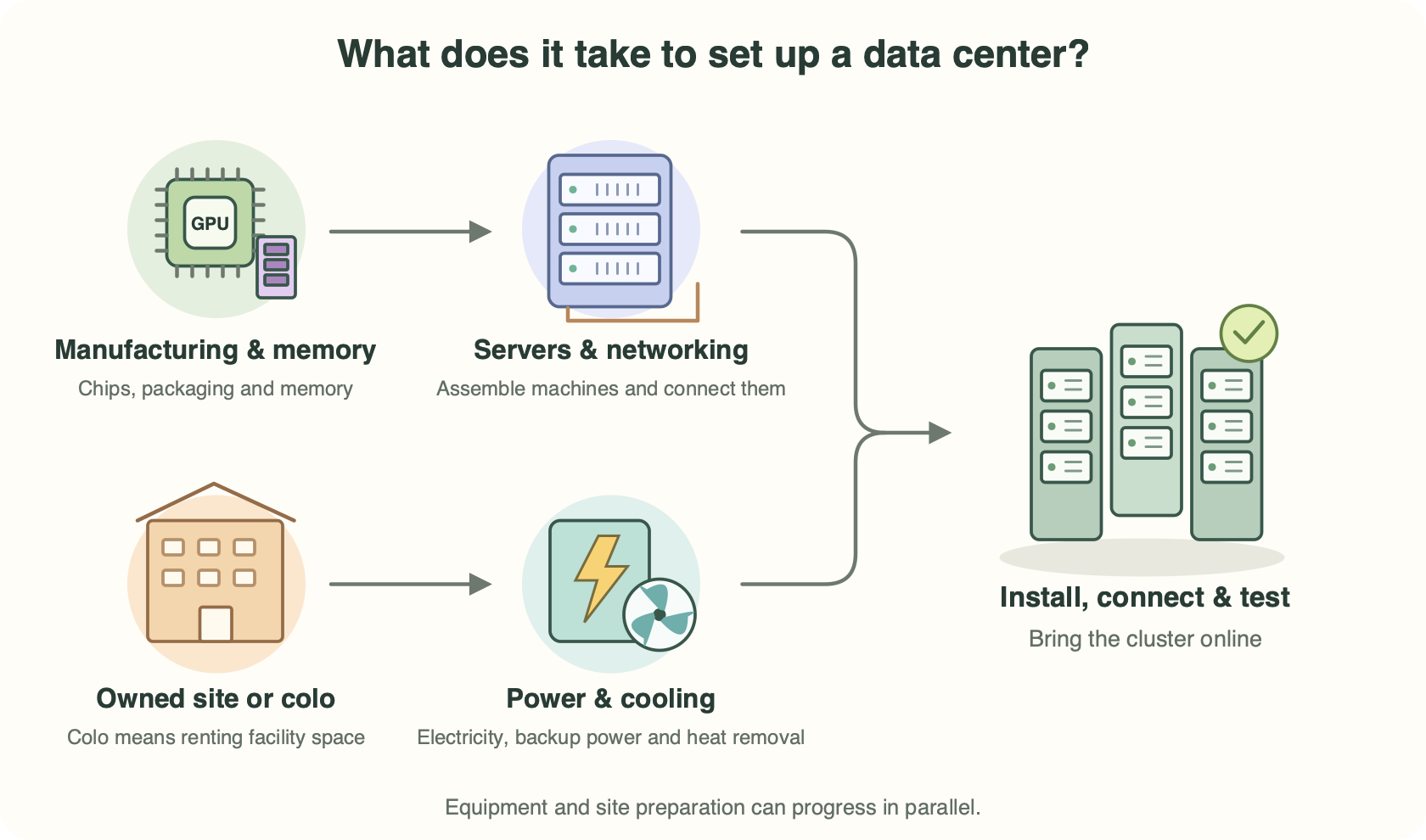
For a provider such as IBM Cloud, bringing a cluster online means lining up the hardware supply chain with a place to run it. Chip and memory manufacturers feed into the server and networking suppliers, while the facility needs enough power and cooling for the equipment. The space can be owned or rented from a colocation provider, often shortened to “colo.” IBM's overview of data centers describes these building blocks and facility options.
Where data centers are taking shape
1,150 tracked sites across 88 countries
What deployment looks like month by month
Say a cloud provider wants to add a GPU cluster in an existing colocation facility. Before placing the order, it needs to know that the site can supply the required electricity and cooling, and that the servers and network will fit the workload. Renting an empty room wouldn't get it very far.
Here's an illustrative six-month schedule. It assumes an existing powered facility and hardware deliveries that fit this window. The months show how the work might overlap, rather than a standard industry lead time or IBM's actual project plan. A project needing new utility infrastructure starts much earlier.
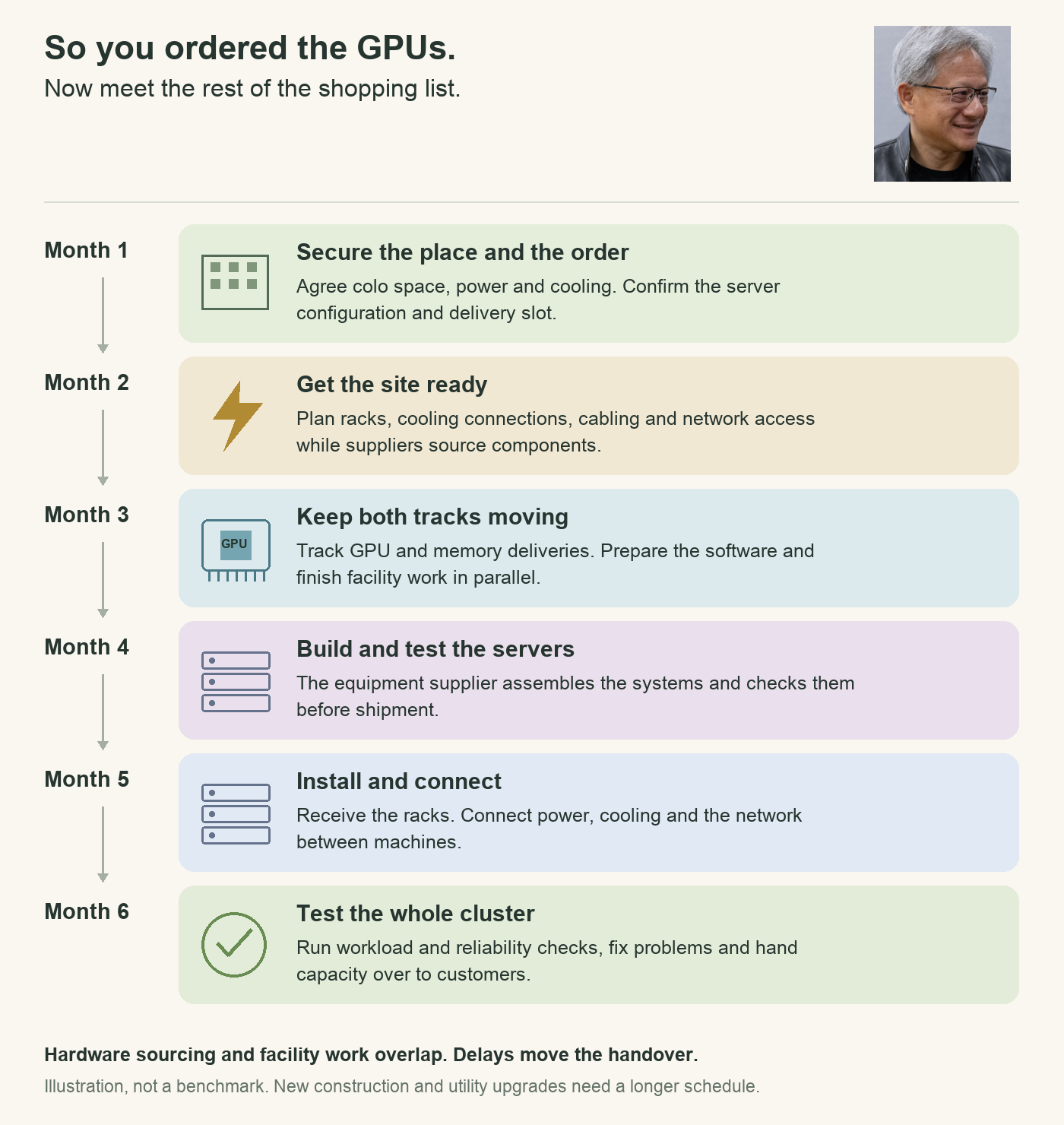

There are nuances to each of these stages though. For example, in month one, the operator signs for colo space and the power allocation that comes with it, and agrees hardware specifications and delivery dates with suppliers. A facility developer arranging a new electricity supply would also need to work with the utility. Signing an energy contract alone doesn't make a site ready to draw that power.
While the server supplier sources GPUs, memory and networking components, the operator can prepare rack layouts, cooling connections and network access. The server manufacturer then assembles and tests the equipment before shipping it. Once it arrives, the installation team connects the racks and checks that the whole cluster works under load. A server that boots successfully still has to work with its neighbours at the performance the customer expects.
Here are real-world examples of gotchas if you're curious. In NVIDIA's account of SoftBank's deployment, limited power availability pushed some testing into off-hours. Networking problems also forced the team to repurpose components from the second cluster to keep the first on schedule. Those are the kinds of dependencies hidden inside a promised delivery date :').
I'll put out a part two soon on why the economics of inference are unlike any other model we've seen before.