The companies are real. The deal below is fictional. Don't sue me pls.
Imagine Cursor wants Fireworks AI to run a model for its coding app. Every time a developer asks Cursor to explain a bug, Fireworks AI runs the model and sends back the answer.
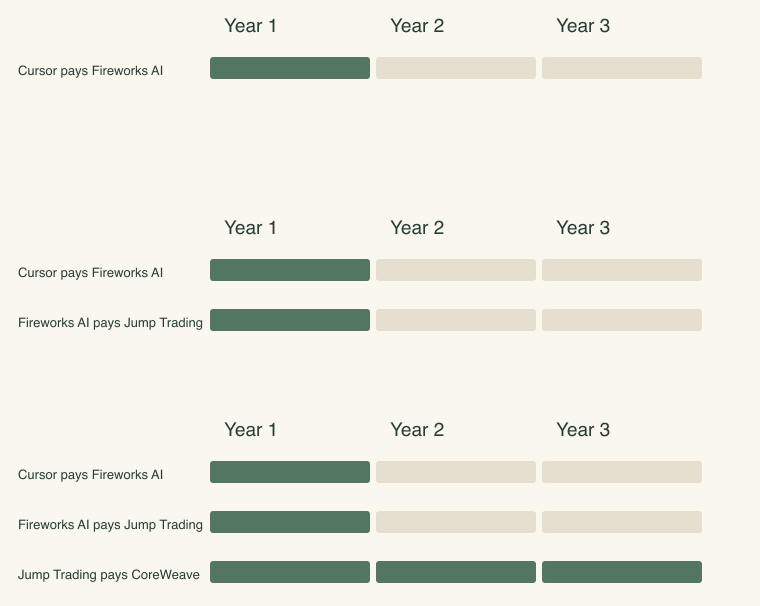
Cursor offers Fireworks AI a year of business. CoreWeave can supply the 64 connected GPUs Fireworks AI needs to serve that customer. There’s just one line in the offer Fireworks AI would like CoreWeave to change.
To serve one year of Cursor’s business, Fireworks would have to commit to paying CoreWeave for three.
In this article
- Who’s who in compute markets
- Who gets the bill in month thirteen? 🤔
- Can Jump sell the remaining two years?
- How does Jump stop owing CoreWeave?
- SF Compute runs the machines and the market
- How labs and inference providers manage the risk
- Financial hedges to save the day
- Sometimes the hedge is another customer
- Does the contract allow resale?
- What if the loan outlasts the customer?
- Limitations of this article
Who’s who in compute markets
Part 1 explains the compute supply chain in more detail. For a quick primer, here we go.
Click to see the players in compute markets
Applications
Cursor · AWS (Amazon Q Developer)
- Use model responses to help their users.
- Can buy inference or run models themselves.
Buy model responses
Inference providers
Fireworks AI · AWS (Bedrock) · CoreWeave (Forge) · Nebius (Token Factory) · Thinking Machines (Tinker)
- Run models and sell responses through APIs.
- Rent or reserve GPUs to serve that work.
Model builders and labs
Thinking Machines Lab · AWS (Amazon Nova) · Cursor (Composer)
- Develop and train models, sometimes starting from an existing model.
- Neolabs are newer model-building companies, such as Thinking Machines.
Both need compute capacity
Buy directly, or choose a route below
Brokers and matching services
- Find a supplier that fits the buyer’s needs.
- In TCEX’s model, buyer and supplier sign directly.
Trading desks
- Can buy capacity and resell shorter bookings.
- When they sign as the buyer, they owe the supplier.
Compute markets
SF Compute · Compute Exchange · AWS (Reserved Instance Marketplace)
- SFC trades usable reserved time. Compute Exchange matches capacity buyers and suppliers.
- AWS lets customers resell eligible Standard Reserved Instances. These are billing discounts, not physical GPUs changing hands.
Access to machines comes from a compute provider
Compute providers
CoreWeave · Nebius · SF Compute · AWS (EC2)
- Operate GPUs, networking and the cloud customers use.
- Neoclouds specialize in GPU infrastructure. AWS is a broader cloud.
The equipment needs an owner and financing
Hardware owners and capital partners
AWS · CoreWeave · Nebius · Blackstone · Magnetar · MUFG
- AWS, CoreWeave and Nebius invest in their infrastructure and operate it too.
- Blackstone and Magnetar have led debt financing for CoreWeave. MUFG led Nebius’s first secured debt facility.
- Lending money doesn’t automatically make the lender the hardware owner. An owner can also hire a separate operator, as in SFC’s partner model.
Companies appear wherever they do the work. AWS builds applications and models, sells inference and compute, owns infrastructure and runs a reservation marketplace. SFC operates a cloud and a market. The names illustrate roles, not a claim that all these companies trade with one another.
Who gets the bill in month thirteen? 🤔
Say Fireworks AI signs a three-year deal with CoreWeave for the 64 GPUs. Cursor’s contract lasts one year. If Cursor leaves at the end of that year, Fireworks still owes CoreWeave two more years of rent. It has to find another customer or keep paying for idle machines.
Now rewind to before Fireworks signs. It has two ways to avoid taking on those extra two years itself.
- Find a supplier that will sign for one year. A broker could introduce Fireworks AI to that supplier, and the two would sign directly. CoreWeave in this example, isn't okay with signing for just one year.
- Buy one year from someone else willing to sign for three. This is where Jump Trading flies in. In our fictional deal, CoreWeave holds firm on three years, so Jump Trading signs with CoreWeave and sells Fireworks AI the first year.
Jump’s compute team has described buying capacity and selling smaller blocks on more flexible terms. The particular contracts and prices below are invented. Let’s follow the second deal path above.
- CoreWeave gets a three-year customer. Jump Trading signs for the whole cluster at $100 a month, with permission to rent that capacity to its own customers. CoreWeave provides the machines and the network.
- Fireworks AI gets one year. Fireworks AI pays Jump Trading $120 a month to use the cluster for Cursor. When the year ends, Fireworks AI can return the machines and stop paying.
- Jump Trading gets the extra $20 a month. In exchange, Jump Trading owes CoreWeave every month for the next three years, even if Cursor leaves and nobody else books.
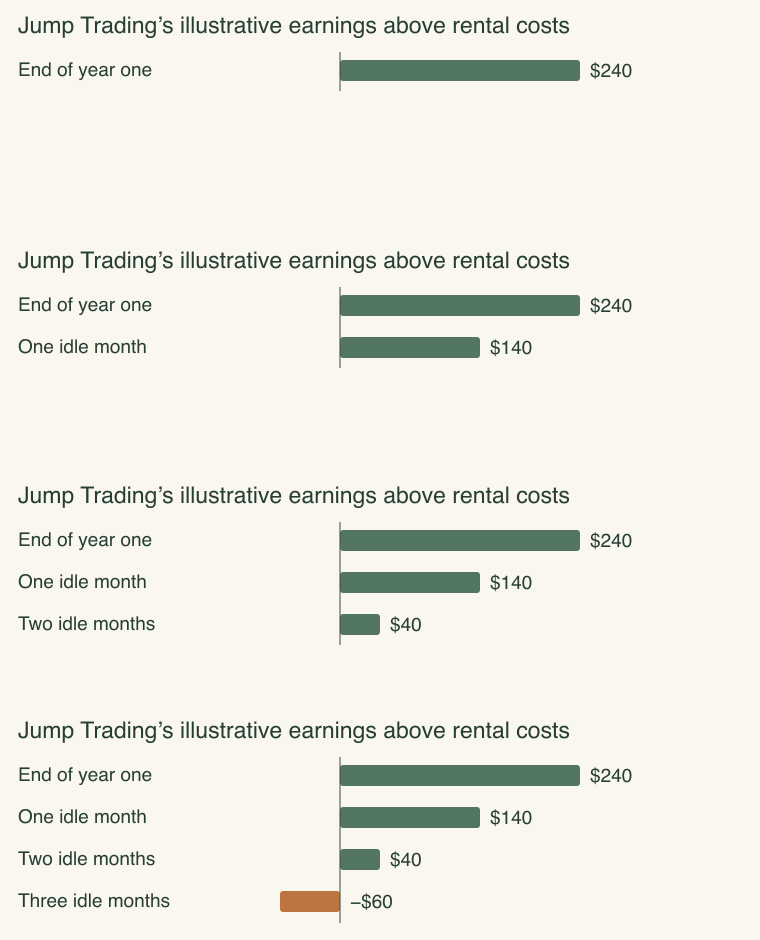
At the end of year one, Jump Trading has collected $1,440 from Fireworks AI and paid CoreWeave $1,200. That leaves $240 before other expenses. Two empty months later, only $40 remains. By the third empty month, Jump Trading has spent $60 more on rent than Fireworks AI paid for the entire year.
Can Jump sell the remaining two years?
Just as Fireworks AI’s booking ends, Jump Trading hears from Thinking Machines Lab, a young company developing its own models (a neolab). The lab wants to start a training run on Monday. The cluster is ready.
But Thinking Machines wants to see how the experiment goes before deciding what to run next.
- Thinking Machines can book a short run elsewhere if it can find 64 connected GPUs for Monday.
- A lab has more options if its software runs on several kinds of chips, something San Francisco Tensor built its training tools to do.
- Jump Trading can offer a lower monthly price if Thinking Machines takes both remaining years. Every week spent waiting for a better offer costs Jump Trading rent, and that week of machine time is gone for good.
Say Thinking Machines chooses the second option and commits to both remaining years at $110 a month.
- Thinking Machines pays Jump Trading $110 each month. It owes those payments for the agreed two years, even if its first training run finishes in a month.
- Jump Trading pays CoreWeave $100 each month. It keeps $10 before expenses while both contracts run.
- If Thinking Machines misses a payment, Jump Trading still owes CoreWeave. Finding a committed buyer fills the booking, but Jump Trading is still responsible for paying its supplier.
How does Jump stop owing CoreWeave?
So far, Jump Trading has stayed between the customer and the supplier, collecting $110 and paying $100. Suppose it now wants to give up the remaining margin and stop owing CoreWeave altogether.
That requires another agreement.
- CoreWeave agrees to accept Thinking Machines as its direct customer. It needs to be comfortable relying on the lab for the remaining payments.
- The parties agree the replacement terms. They settle the price, remaining duration, any deposits and any payment for the handoff. The lab’s $110 resale price and Jump Trading’s $100 supplier price belong to the two existing contracts.
- CoreWeave releases Jump Trading from the future payments. CoreWeave then invoices Thinking Machines under the replacement agreement. If Thinking Machines later fails to pay, Jump Trading has no further rental obligation under that release.
This complete replacement and release is often called a novation. Jump Trading’s permission to rent the machines to other customers allowed it to sell bookings while it kept paying CoreWeave. To leave the deal entirely, it also needs CoreWeave to release it from that promise to pay.
SF Compute runs the machines and the market
Our fictional Jump desk takes a long booking and sells shorter ones. SF Compute supplies compute from clusters it operates. In its partner model, an investor can own the hardware while SFC runs the cloud and the market.
- An investor owns the cluster. SFC helps design, build and operate it for the owner.
- A lab reserves capacity. The lab can use the machines and sell hours it doesn't need through SFC's market.
- SFC operates the machines and the market. A buyer gets usable compute, with SFC managing delivery rather than simply introducing two parties.
There are real customers doing this. Standard Intelligence reserves for its busiest workloads and resells spare hours. Roboflow buys shorter reservations on the other side. The lab gets some money back when another buyer appears. Resale by itself guarantees neither a buyer nor a price.
How labs and inference providers manage the risk
A lab can commit to GPUs before it knows whether its next experiment will work. An inference provider can commit before it knows how much its customers will use. Both can end up owing for machines they no longer need.
- Commit ahead of time. OpenAI buys reserved capacity from CoreWeave. The contract secures access to machines for future dates. It isn't a cash-settled future.
- Keep more sourcing options open. Anthropic describes running across Trainium, TPU, NVIDIA and AMD hardware. That flexibility helps it choose capacity by price and performance. The same filing describes take-or-pay commitments against substantially consumption-based customer revenue. Flexibility doesn't make those bills disappear.
- Ask customers to commit too. Fireworks offers enterprise reservations, typically for a year. Customers keep paying until the reservation ends, even when they don't use it. Usage beyond the reservation goes on the on-demand bill.
- Buy shorter access when available. CoreWeave offers on-demand and spot capacity. A shorter commitment leaves the buyer exposed to availability and the price of the next booking. Spot capacity can also come with interruption risk.
There’s a tradeoff in each choice. Committing protects access but creates a bill. Reselling needs another buyer. Switching providers needs software that can actually run there.
Financial hedges to save the day
Suppose Jump finds another customer, but GPU rents have fallen. It still owes CoreWeave the agreed rent, while its next customer expects a cheaper price. Keeping the machines busy may no longer cover the bill then.
This is where a financial hedge comes in. 🙌 Jump could pay another party for a contract that pays out if rental prices fall below an agreed level. That payment could help cover the shortfall. A buyer planning to rent GPUs later can seek protection against the reverse problem, rising prices.
Click to see real examples of hedges through custom contracts (FalconX, Jump, SIG)
Companies are already building and negotiating these contracts, though the examples below are at different stages.
- FalconX has executed a compute-price swap. FalconX acted as dealer, with Robert Leshner, founder of Superstate, on the other side. The contract references Ornn’s OCPI H100 index. That benchmark tracks GPU rental prices in dollars per GPU-hour, giving the contract a price against which to calculate payments.
- Jump structures protection against falling rental income. The WSJ describes puts for neoclouds and infrastructure developers. Its illustrative deal protects a $4-per-GPU-hour selling price. Settlement could involve cash or Jump taking the compute to rent out. The put buyer pays a premium for that protection.
- Susquehanna (SIG) reports inquiries about index-linked puts. Data centers and neoclouds are exploring protection to help secure bank financing.
The catch is that the protection costs money and follows a specified GPU price. If the actual cluster gets more expensive than that reference price, the payout may not cover the difference. Jump still needs a renter, and Fireworks still needs to book the machines.
This part is going to get mathy :) Click for the walkthrough
Fireworks AI needs more GPUs. What will they cost?
Cursor wants more work next month than the original cluster can serve. Fireworks agrees on Cursor’s price today, but plans to book the extra machines next month, for that month only. The original year-long cluster booking continues at its agreed rent. This is a separate purchase for the extra work.
Warning, this next part is going to get mathy.
- The extra order is 1,000 GPU-hours during next month only. That could mean 10 GPUs for 100 hours each. It is 1,000 hours in total, not a year-long booking.
- Fireworks budgets $2 per hour, or $2,000. CoreWeave will quote this new booking next month. The original cluster's price stays fixed.
- Cursor's price is already agreed. If the extra machines cost $3 per hour, Fireworks has to cover the $1,000 increase.
Quick guide to spot, forwards, futures, calls and puts
First, separate renting machines from a contract that pays money when prices change. The prices below are made up. Each example covers 1,000 GPU-hours unless it says otherwise. A benchmark is the published rental price used to calculate a financial contract’s payment.
- On-demand means rent machines as you need them. At $3 per GPU-hour, using 1,000 hours costs $3 × 1,000 = $3,000. You pay for the usage without signing a multiyear booking.
- A spot price is the current market price for immediate delivery. That is the financial-market meaning of spot. If GPU time available now trades at $3 per hour, buying 1,000 hours costs $3,000. The word describes when you buy access. It does not, by itself, mean the provider can interrupt your work.
- Cloud “Spot” instances are a specific interruptible product. Providers such as AWS sell spare machines at a discount and can take them back. Suppose the price is $1 instead of $3. Completing all 1,000 hours would cost $1,000 instead of $3,000. But the provider can stop those machines while your job is running. You may have to resume from saved progress on another machine or redo work you didn’t save. That is what AWS means by a Spot interruption.
- A physical forward books machine time ahead of use. Agree today to take 1,000 hours next month at $2 per hour. The supplier provides the agreed capacity and you owe $2 × 1,000 = $2,000. If you only need 600 hours, the other 400 × $2 = $800 is still part of your bill. Cloud reservation products vary. An AWS Reserved Instance, for example, primarily provides a billing discount.
- A cash-settled future pays the difference between an agreed price and the benchmark. An exchange standardizes the contract. Buying, or going long, at $2 protects a buyer against rising prices. It also creates a payment obligation if prices fall.
- Benchmark rises to $3. The buyer receives ($3 − $2) × 1,000 = $1,000 from the seller.
- Benchmark falls to $1. The buyer pays the seller ($2 − $1) × 1,000 = $1,000.
- Selling, or going short, gives the opposite payments. This cash-settled contract delivers money, not GPUs. Fees and funding are additional costs.
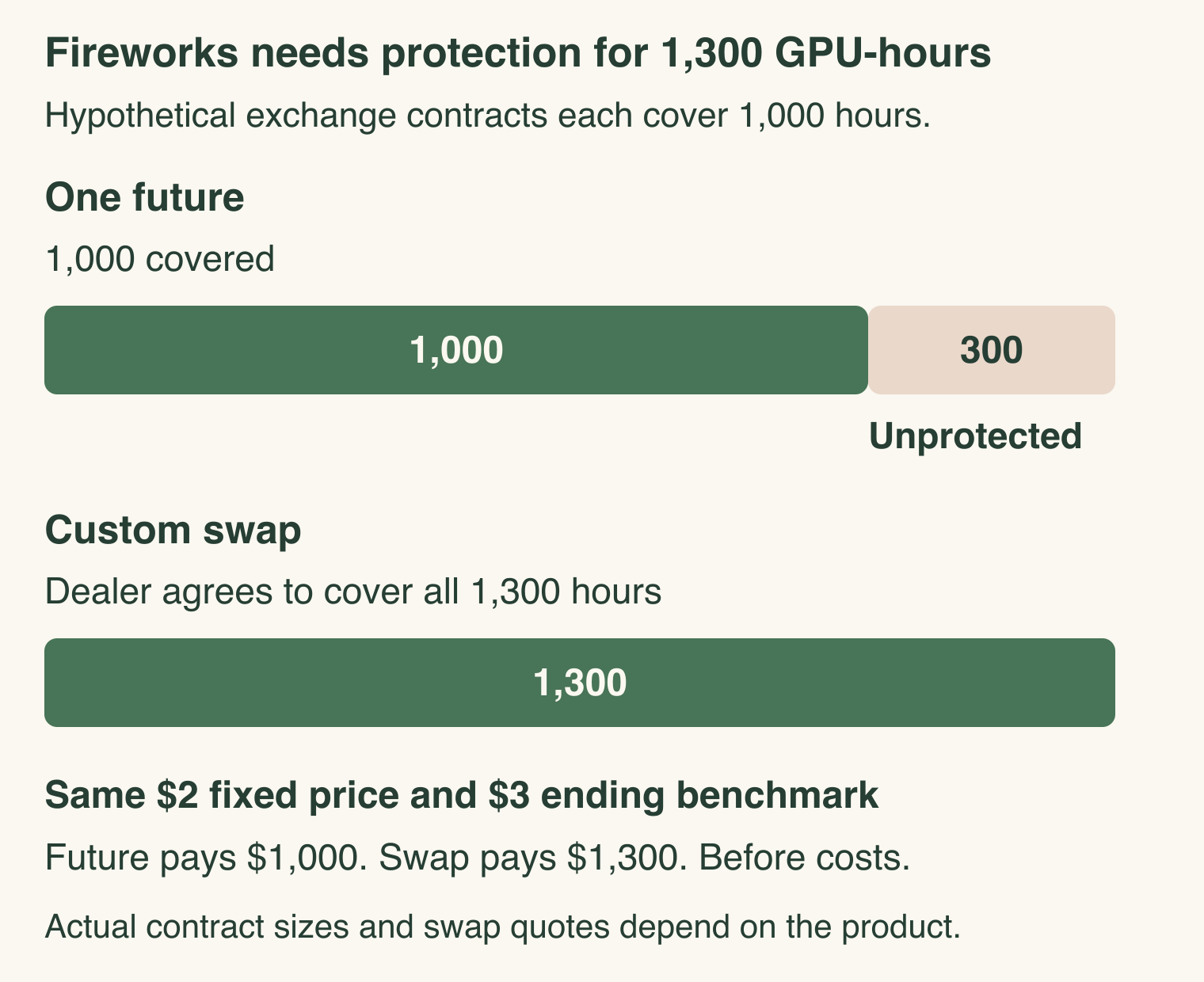
- A swap privately agrees a payment formula. For example, two parties agree to compare $2 with the benchmark each month for three months, covering 1,000 hours per month. The party paying the fixed price receives $1,000 in a month when the benchmark is $3 and pays $1,000 when it is $1. They negotiate the dates, quantities and collateral directly. The payment math can match. The difference is whether the exchange defines the contract or the parties negotiate its terms. Here is a hypothetical example of how that affects the fit.
- An option buys a choice, for an upfront cost. The premium is what you pay for the option. The strike is the price where its protection starts. Suppose a cash-settled option has a $2 strike and costs $0.20 per covered hour. The premium is $0.20 × 1,000 = $200. If it expires without paying anything, the buyer loses that $200 and owes no further option payment.
- A call protects against rising prices. With that $2 strike and $200 premium, a benchmark of $3 produces ($3 − $2) × 1,000 = $1,000. Subtract the $200 premium and the option’s net gain is $800, before other fees. At a benchmark of $1, it pays nothing and the buyer loses the $200 premium.
- A put protects against falling prices. With a $2 strike and $200 premium, a benchmark of $1 produces ($2 − $1) × 1,000 = $1,000. After the premium, the option’s net gain is $800, before other fees. At a benchmark of $3, it pays nothing and the buyer loses the $200 premium.
- Margin is a deposit backing your promise to pay. Suppose your futures broker asks for $200. You move $200 into the margin account. If the trade loses $50, that reduces the balance to $150, before any top-up requirement. After you close and settle the trade, you can withdraw any remaining balance. The loss is $50. The full $200 deposit wasn’t a fee, although tying it up can have a funding cost.
Here are the two prices to keep separate.
- Today, Fireworks fixes $2 per GPU-hour in the financial contract. It enters a cash-settled future covering those 1,000 extra hours for next month only. The $2 sets the reference for its financial payments. Fireworks has not paid $2,000 to reserve machines from CoreWeave.
- Next month, Fireworks accepts CoreWeave’s quote for those 1,000 extra hours. The booking covers that month only. The quote could be $3, $2 or $1.50 per GPU-hour. For the first comparison below, assume the published benchmark ends at the same price as CoreWeave’s quote.
The future stays fixed at $2 in all three scenarios. The $3 is one possible later machine price. Once this extra booking and the future finish, Fireworks has no machine booking or price protection for later months from these contracts.
What does the futures hedge cost?
- $200 in initial margin collateral. This uses the indicative roughly 10% margin proposed by CME Group (a futures-exchange operator). For our $2,000 position, 10% × $2,000 = $200. Requirements can change and the broker can ask for more. The deposit remains an asset subject to trading losses.
- $30 in trading fees for the whole trade. Assume this covers opening and closing the position, including broker, exchange and clearing charges. It is an illustrative total, not a monthly subscription or an actual quote.
- $2 to fund the collateral for a month. Assume a 12% annual funding cost. $200 × 12% ÷ 12 = $2. Extra margin calls could increase this cost.
- $2 per hour is the executable futures price. It already reflects execution. We don't add a separate bid-ask spread again, and we don't assume today's machine rental price must equal the futures price.
The assumed cost for this one-month hedge is $30 + $2 = $32 in total. The $30 covers the trade. The $2 covers one month of funding.
The separate $200 is collateral held in the margin account. After Fireworks closes the trade and settles its gains or losses, it can withdraw the remaining balance. We count trading losses and the cost of funding the deposit, rather than treating the deposit itself as a $200 fee. A futures buyer generally doesn’t pay the upfront premium an option buyer pays.
Three price scenarios. One $2,032 bill.
- Fireworks pays CoreWeave for the machines next month. In the rising-price scenario, it accepts a $3-per-GPU-hour quote, so the invoice is $3 × 1,000 = $3,000. The unchanged-price and falling-price scenarios have invoices of $2,000 and $1,500 instead.
- The future gains or loses money against the $2 price fixed today.
- Benchmark at $3. Fireworks receives ($3 − $2) × 1,000 = $1,000.
- Benchmark at $2. The gain or loss is ($2 − $2) × 1,000 = $0.
- Benchmark at $1.50. Fireworks pays ($2 − $1.50) × 1,000 = $500.
- Add $32 in total fees and funding for this one-month hedge. The combined bill is $2,032 in each scenario below, because we assumed CoreWeave’s rate matches the benchmark.
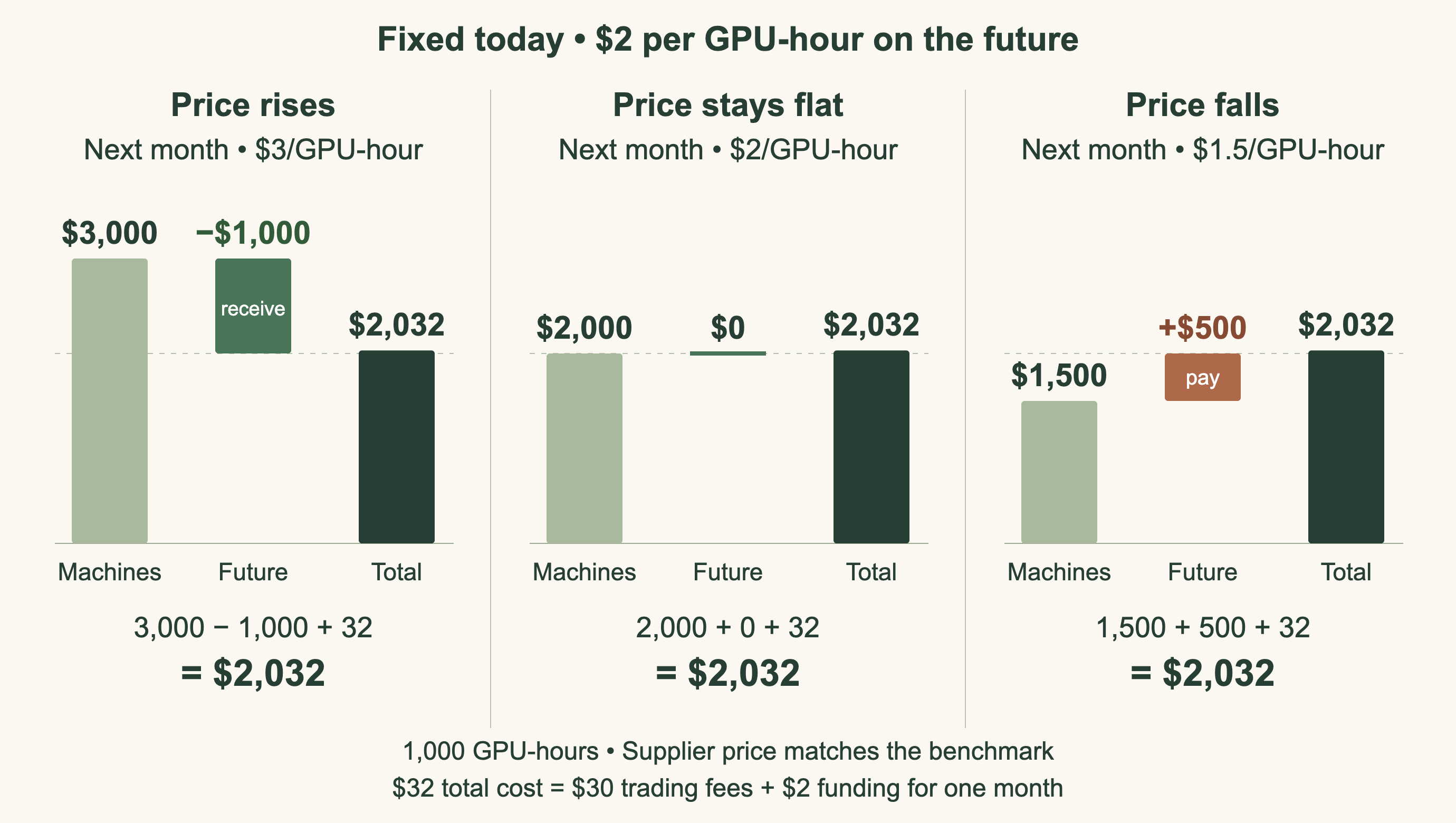
Cleared futures generally settle gains and losses daily, so Fireworks may need cash for losses before it benefits from a cheaper machine invoice.
What if Fireworks buys a call instead?
As an alternative to the future, suppose Fireworks buys a hypothetical cash-settled call covering the same 1,000 extra hours for next month only, with a $2 strike and $200 premium paid today. The call expires at the end of that month and provides no protection for later months. Fireworks still books and pays for the machines separately. Again, assume the supplier rate matches the benchmark.
- Prices rise to $3. $3,000 machine bill − $1,000 payout + $200 premium = $2,200.
- Prices fall to $1.50. $1,500 machine bill + $200 premium = $1,700. The call expires without a payout.
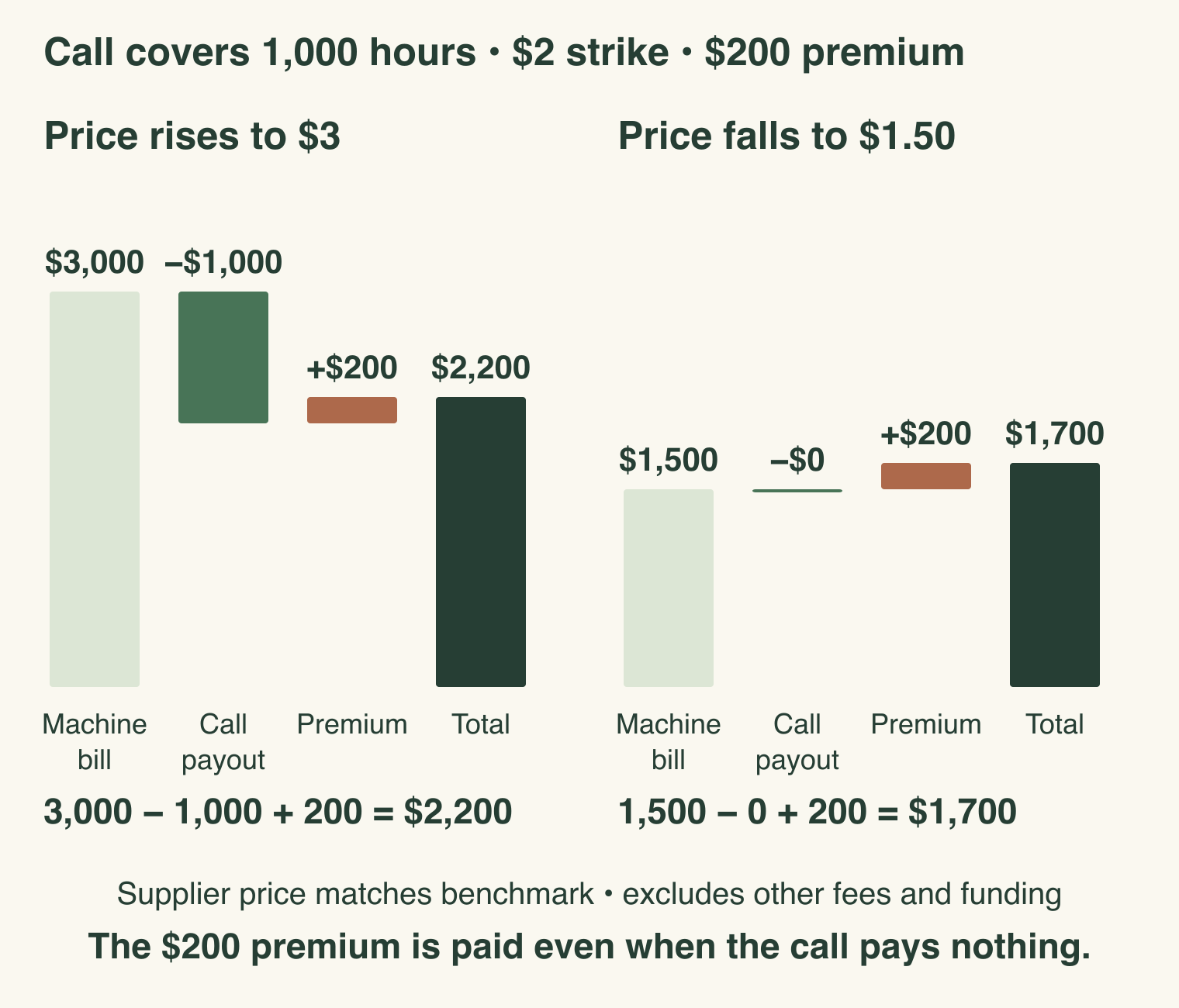
Those totals are before option trading fees and funding costs. The premium buys the ability to benefit from falling prices without the future's $500 loss in that second case. A suitable option still needs a willing seller and an acceptable quote.
What if CoreWeave charges more than the benchmark?
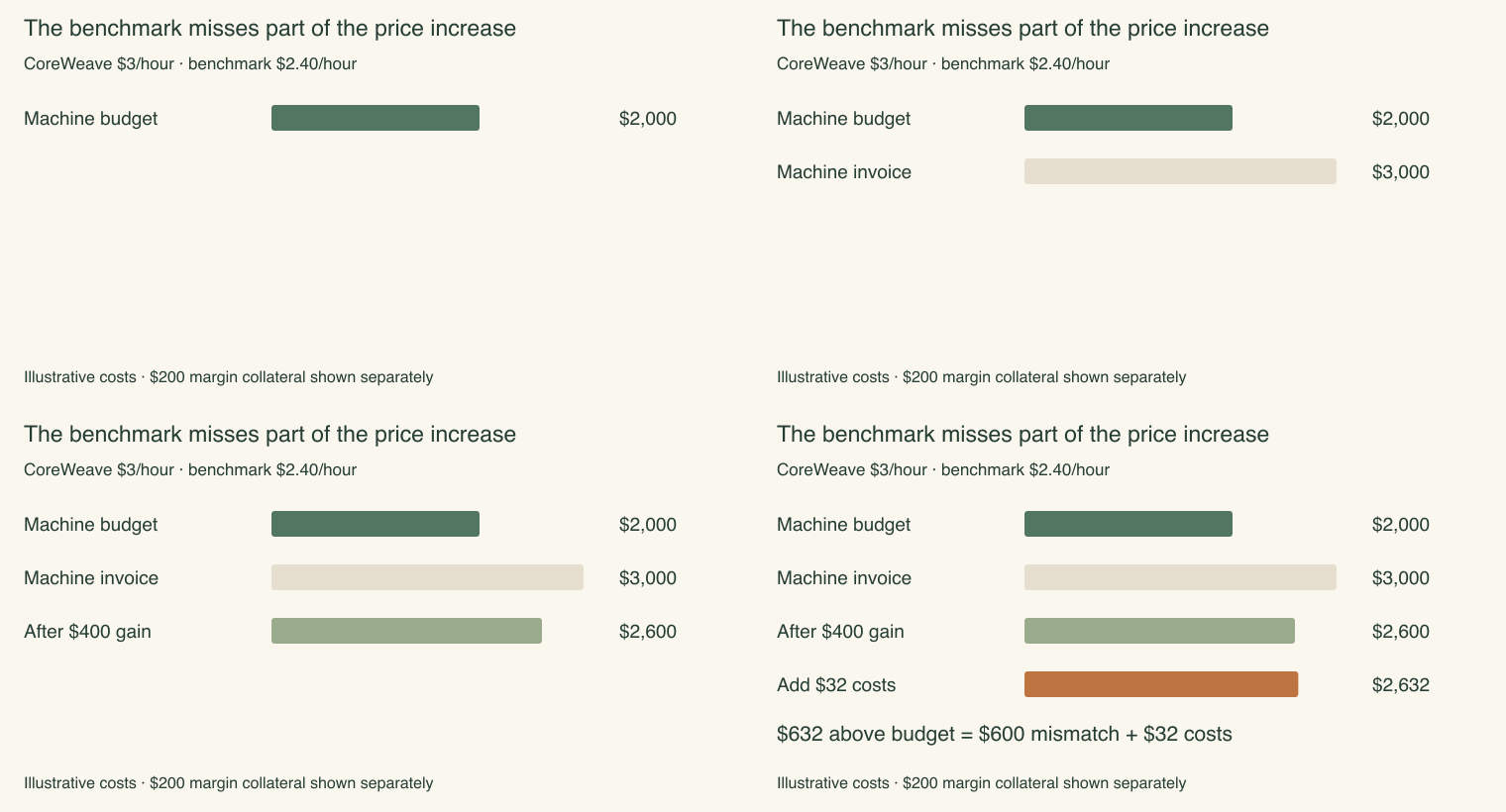
Now let the supplier rate and benchmark move differently. Keep the same 1,000-hour future and $32 allowance.
| CoreWeave’s rate | Benchmark | Machine invoice | Futures gain or loss | Fees and funding | Combined cost |
|---|---|---|---|---|---|
| $3.00 | $3.00 | $3,000 | Receives $1,000 | $32 | $2,032 |
| $1.50 | $1.50 | $1,500 | Pays $500 | $32 | $2,032 |
| $3.00 | $2.40 | $3,000 | Receives $400 | $32 | $2,632 |
That last row is the one I’d want to see before signing. CoreWeave charges $3 for its particular cluster, but the benchmark only reaches $2.40. The hedge pays exactly what it promised. Fireworks still spends $632 above its machine budget. Of that, $600 comes from the price mismatch and $32 from fees and funding.
That mismatch is basis risk. You can change the prices and cost assumptions independently to see when the gap opens up.
What if GPU rents fall?
Go back to Jump before it finds Thinking Machines. It owes CoreWeave for unfilled months and doesn't know what the next customer will pay.
- Sell a future. On an illustrative 1,000-hour short at $2, a $1 benchmark produces a $1,000 gain. A $3 benchmark produces a $1,000 loss. Fees and funding come on top, and losses may need cash before rental income arrives.
- Buy a put. Pay a premium for protection against falling rental prices while keeping the benefit of a rise. This is the opposite exposure from Fireworks, which fears a higher purchase bill.
For one GPU-hour, suppose a hypothetical put has a $2 strike and a 40-cent premium.
- Rent falls to $1. $1 rental income + $1 put payout − $0.40 premium = $1.60 before supplier costs.
- Rent rises to $3. The put pays nothing. Revenue after the premium is $2.60 before supplier costs.
- Nobody rents the hour. At a $1 benchmark, the put produces $0.60 after its premium, with no rental income to add.
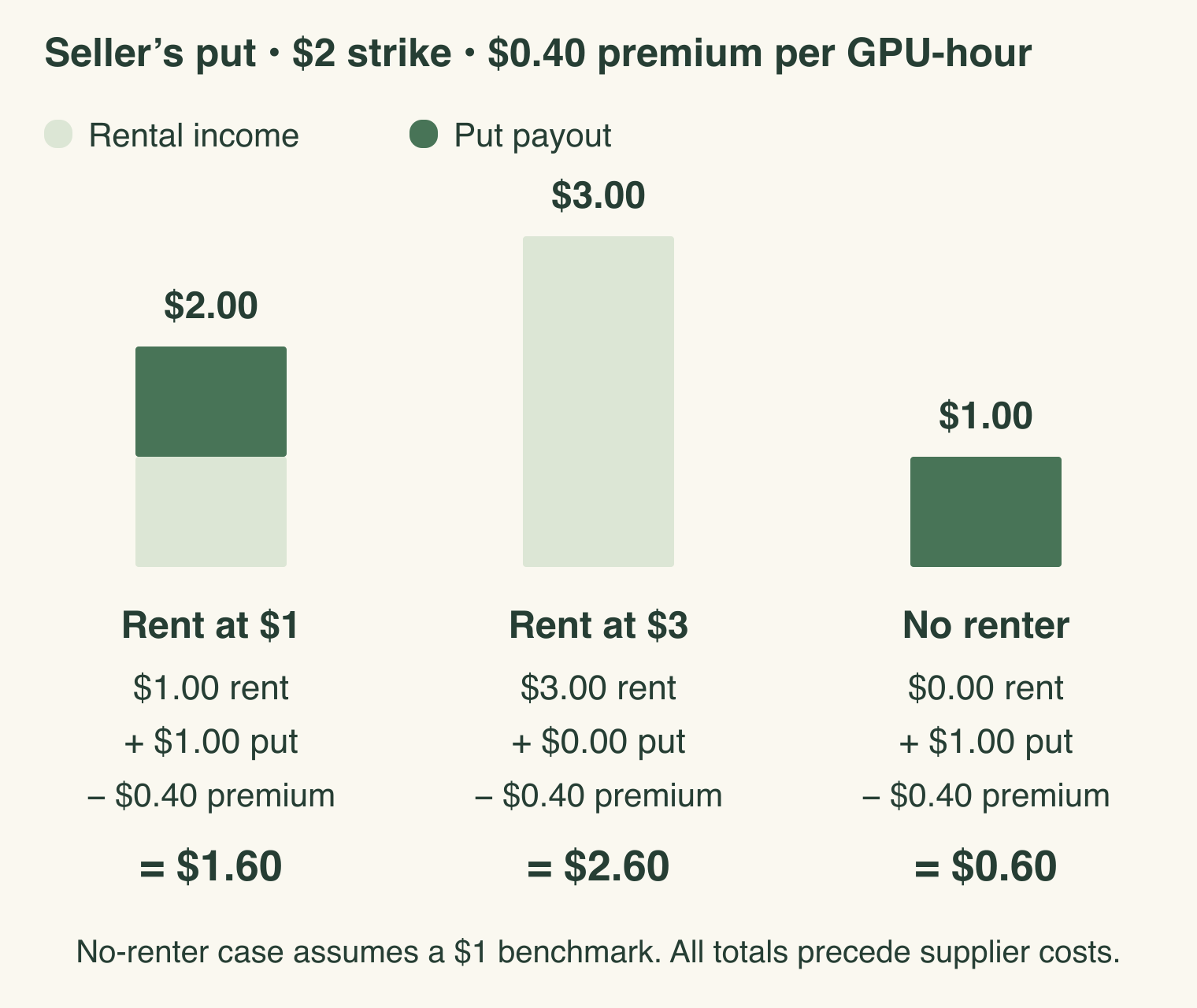
The premium lowers the protection's net value. And the put can pay while the overall trade still loses money. Neither a put nor a future guarantees a customer for the cluster.
Sometimes the hedge is another customer
A provider can also line up a customer to buy capacity it can't sell to anyone else.
- CoreWeave and NVIDIA. A disclosed agreement initially valued at $6.3 billion obligates NVIDIA to buy covered residual unsold capacity through April 2032, subject to delivery, availability and termination terms.
- Nebius and Meta. Their March 2026 agreement includes up to $15 billion of additional available capacity over five years. Nebius intends to sell it to other customers first, with Meta buying the remainder.
- Other bills need other hedges. CoreWeave discloses power, interest-rate and currency derivatives. These address electricity, financing and exchange-rate exposure, rather than guaranteeing GPU rental income.
A creditworthy buyer can make a cluster easier to finance. The contract still needs someone to deliver working machines, and someone has to pay if that buyer defaults.
Does the contract allow resale?
Thinking Machines needs access to a working cluster. A seller's willingness to hand it over isn't enough.
| Published example | What the transfer terms say |
|---|---|
| Lambda platform guidelines | Resale or rental requires express permission, which can appear in the order or documentation. |
| Nebius agreement dated March 2026 | This version requires written consent to transfer contractual rights or obligations. |
| Crusoe managed inference terms | Standalone distribution of the covered services is restricted. Resale can require a separate agreement. |
| SF Compute marketplace terms | Customers can resell unused capacity on SFC’s marketplace with its approval, once they’ve paid for it and received access to working GPUs. |
- A resale market finds a bid. SFC can match another buyer to the reserved hours. The price and dates of that bid determine what the holder can recover.
- A settlement ledger records the exchange. SFC's Abel ledger transfers credits and dated capacity together. A ledger entry doesn't release a separate supplier obligation or guarantee that a future cluster gets built.
- A full exit needs a release. In our fictional Jump deal, CoreWeave must agree to stop billing Jump. Reselling the remaining months doesn't accomplish that by itself.
What if the loan outlasts the customer?
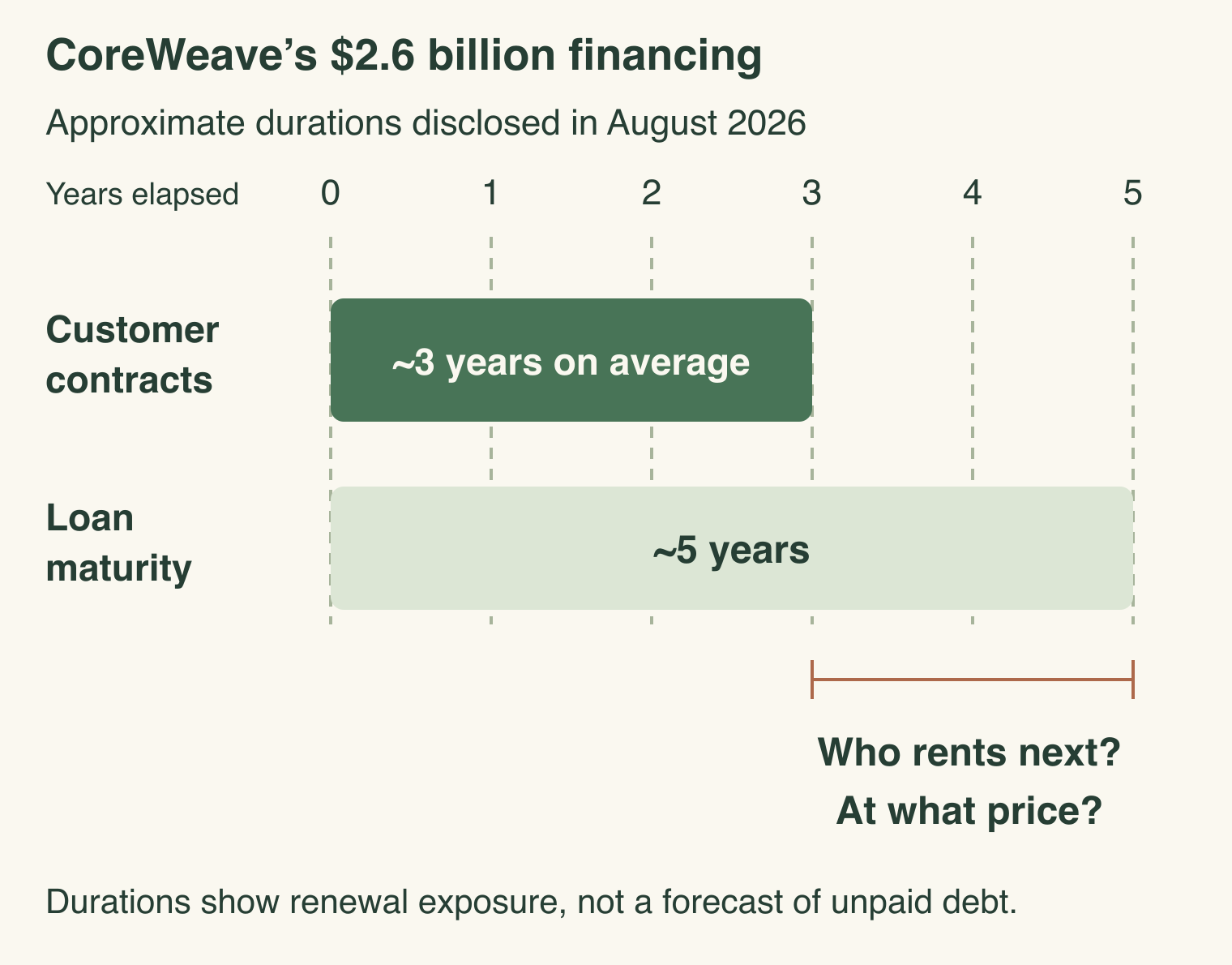
Three years sounded long to Fireworks. But look at CoreWeave’s real-world example. It announced a $2.6 billion loan facility with roughly a five-year maturity, backed by customer contracts averaging about three years. Those contracts can end before the loan does.
- Who rents the machines next? Does the customer renew, or does CoreWeave find someone else?
- At what rent? The next customer might pay less while CoreWeave still owes the debt.
- What if a customer stops paying? The lender may have to recover money from the equipment. Residual-value insurance can protect equipment value under the policy’s terms.
Limitations of this article
- The running deal is fictional. Real companies and sources, invented transactions and worked prices.
- I can't see anyone's hedge book. Public trades don't establish that labs routinely use listed futures or that SFC hedges its own exposure.
- Some deal terms aren't public. FalconX hasn't disclosed the swap's size, maturity or who benefits from rising prices. Jump's $4 floor is illustrative. Neither report gives an actual put premium.
- Listings don't prove liquidity. ICE's notice uses hypothetical settlements, while NYMEX extended review of the CME contracts to January 8, 2027, subject to conditions.
- I've simplified the math. We use 1,000 hours. CME proposes 730-hour contracts. Fees, funding costs and option premiums are illustrative. Changing demand, margin calls and settlement terms can change the bill.
Thanks to Chintan Doshi for proofreading the article.